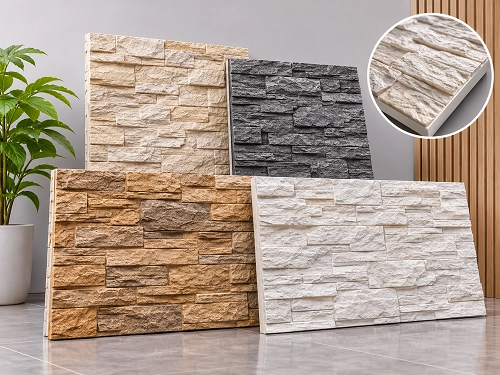
Decorative PU stone panels are moulded polyurethane wall units that reproduce the relief and colour of stone at a fraction of the handling weight. The look is easy to judge from a photo. The specification is not. On 1 January 2027, China's revised building material fire classification, GB 8624-2025, takes effect and replaces the 2012 edition. In July 2026, the American Chemistry Council also published updated guidance on code requirements for polyurethane foam used as interior finish or trim. Both point buyers to the same question: how was the product tested, and does that match how it will be installed?
Key takeaways
- Panel depth affects the look, packing volume and, in some markets, the fire compliance route.
- A fire grade belongs to a tested product and configuration, not to “PU” as a material.
- Long panels move more with temperature, so joints and fixing need planning.
- Approve a physical sample and written data before bulk production.
What is a PU stone panel made of, and why does it matter?
A polyurethane stone panel is formed in a mould that carries the stone texture, then coloured to match the intended finish. OUZHI, a PU stone manufacturer in Haining, Zhejiang, describes its range as made from high-density polyurethane, with options for interior and exterior design projects.
“High-density” is a description, not a number. Ask for the density in kg/m³ and the weight per panel. As a rule of arithmetic, every 100 kg/m³ of density adds 1 kg per m² for each 10 mm of solid thickness. Textured and hollow-backed panels are not solid blocks, so a weighed sample is more reliable than a calculation from the outside dimensions.
Panel formats: sizes, depth and where each fits
Depth is the detail most often overlooked. It sets how strong the shadow lines look, how the panel meets sockets, door frames and corners, and how many cartons fill a container. The table uses one listed model from each format; other models may differ.
| Format | Sample model | Listed size (mm) | Face area (m²) | Suggested use |
|---|---|---|---|---|
| Thin stone panel | G001-1 | 1200 × 600 × 16 | 0.72 | Renovations and rooms where wall depth is tight |
| Stone panel | A001-1 | 1200 × 600 × 30 | 0.72 | TV walls, reception and retail feature walls |
| Mushroom stone, hollow | H001-5 | 1200 × 600 × 50 | 0.72 | Raised texture; check edge and impact strength |
| Rock stone | C001-1 | 1200 × 600 × 60 | 0.72 | Rugged feature walls viewed from a distance |
| Mushroom stone, thick | J001-5 | 1200 × 600 × 80 | 0.72 | Deep shadow effects; plan corners and reveals |
| Rock stone, big size | K001-1 | 2900 × 600 × 50 | 1.74 | Tall or wide walls with fewer end joints |
Face area is length × width. Net coverage can be lower where edges overlap or interlock. Suggested uses are design guidance, not tested ratings.
The wider range includes PU mushroom stone, PU rock stone and modular PU component panels. For colour, start with a reference such as Alabaster and confirm it against a physical sample under the project lighting.
Worked example: estimating quantity
For a 30 m² wall using 1200 × 600 mm panels: 30 ÷ 0.72 = 41.7. With an illustrative 10% cutting allowance, 41.7 × 1.10 = 45.8, so order 46 panels. Increase the allowance for many openings, corners or a pattern that must align, and check the effective coverage of the chosen model first.
Fire performance: the question to settle first
Polyurethane is combustible. Flame-retardant formulations can change how it behaves, but “fire retardant” on a quotation is not a classification. Request a test report that names the product, thickness, density, mounting method, laboratory, standard and date.
China: GB 8624-2025
The new edition was published on 31 December 2025 and takes effect on 1 January 2027. A published summary of the changes says smoke, burning droplets and smoke toxicity are now assessed as part of the grade, and that specimens and mounting should reflect actual use. For projects in China, ask which edition a report follows and confirm with the design institute or authority whether older reports will be accepted.
United States and IBC-based markets
The American Chemistry Council guidance, based on the 2024 codes, summarises that foam plastic trim is limited to ½ inch (12.7 mm) thick, 8 inches (about 203 mm) wide and 10% of the wall or ceiling area, with a minimum density of 20 lb/ft³ (about 320 kg/m³). A 1200 × 600 mm stone panel is far wider than that, and even a 16 mm model is thicker. Specifiers should therefore not expect a foam stone feature wall to qualify as trim.
As interior finish, foam plastic generally needs a thermal barrier, such as ½-inch gypsum board between the foam and the room, unless a permitted route such as large-scale testing applies. A barrier behind a decorative panel does not separate its exposed face from the room. An ASTM E84 result alone is not sufficient for foam used as interior finish; NFPA 286 is one of the relevant large-scale tests. The guidance does not address faux stone specifically, so confirm the route with the authority having jurisdiction.
Exterior walls are a separate matter. On commercial buildings of construction Types I–IV, the IBC can require the complete wall assembly containing foam plastic to pass NFPA 285.
European Union
Reaction to fire is commonly expressed as a Euroclass under EN 13501-1, with added indicators for smoke and flaming droplets. A CE mark is not a fire grade by itself. It follows a declaration under the Construction Products Regulation and applies where a product is covered by a harmonised specification or a European Technical Assessment. Ask for the declaration and read the declared performance.
Thermal movement and weathering
Allow for expansion
As a reference point only, one manufacturer's data sheet for a 135–145 kg/m³ rigid PIR board, a related foam, gives a linear expansion coefficient of 5–8 × 10⁻⁵ per K. Applying that range to a 40 °C temperature swing gives about 2.4–3.8 mm of movement over 1200 mm, and 5.8–9.3 mm over 2900 mm. These are not OUZHI test values. They show why large panels on a sunlit wall need a joint and fixing design based on data for the actual product.
Protect the surface from UV
Aromatic polyurethanes can yellow quickly under ultraviolet light, while aliphatic types discolour little or not at all. The finish coating therefore matters for facades. Ask what coating system is used, what weathering test it has passed, how colour change was measured and how to repair or recoat it.
Installation: a practical sequence
Follow the instructions for the product you buy. The steps below reflect common practice, including published guides for faux stone panels from other makers.
- Check the wall. It should be sound, flat, clean and dry. Fix damp problems before covering them.
- Acclimate. Store panels flat on site, away from sun and heat. The cited guides call for 24 to 48 hours.
- Dry-lay. Mix cartons, plan the joints and avoid repeating the same texture side by side.
- Cut and test fit. Use a fine-toothed saw, eye protection and dust control.
- Fix. Use the adhesive and corrosion-resistant fasteners approved for the substrate and exposure.
- Seal and touch up. Finish joints, penetrations and screw heads. Outdoors, plan drainage so water cannot be trapped behind the panels.
Fireplace surrounds need particular care. Keep foam panels out of fireboxes and away from flames and embers. Follow the appliance maker's clearances to combustible materials and local code.
Foam panels also change the site hazard profile. Cutting stone, concrete or brick can release respirable crystalline silica. Cutting PU avoids cutting mineral stone, but drilling a concrete or masonry wall to mount it still needs silica controls.
PU stone or natural stone?
PU stone is a strong choice where low weight, fast handling, repeatable texture and custom shapes matter. Natural stone remains the better fit where non-combustibility, high impact and abrasion resistance, or a long exposed service life are decisive. At ground level in busy corridors, entrances and car parks, ask for impact data or protect the panels.
How to buy from a PU stone manufacturer
Put these items in your inquiry:
- Model, colour, finished size, effective coverage and tolerance
- Density and weight per panel
- Fire report for your market, matching the supplied thickness and mounting
- Water absorption, weathering and impact data where relevant
- Recommended adhesive, fasteners, joints and corner details
- Carton size, panels per carton and estimated container loading
- A retained, signed sample for batch colour comparison
OUZHI's FAQ states a minimum order of 100 pieces for standard styles, with custom styles depending on the design. Samples carry a fee that is refunded when an order is placed. Typical production for standard styles is about 20–25 days for a 20-foot container and 25–30 days for a 40-foot high cube. Confirm current terms in your quotation. Custom designs are available on an OEM basis.
The company's company profile also reports a new factory with automated production lines, with completion planned for March 2027. Buyers can browse the global case gallery for application ideas.
Frequently asked questions
Can decorative PU stone panels be used outdoors?
Many series can, when the product, coating and fixing method suit the climate and local code. Confirm weathering and fire data for the exact model.
Are PU stone panels fireproof?
No. Polyurethane is combustible. Rely on the classification of the tested product and the rules for your building.
Can they be installed over an existing wall?
Often, if the existing surface is sound, dry and able to hold the adhesive or fasteners. Loose paint, damp and weak plaster must be corrected first.
How are they cleaned?
Start with a soft brush or damp cloth and mild detergent. Test a hidden area and avoid solvents or high-pressure washing unless the supplier approves them.