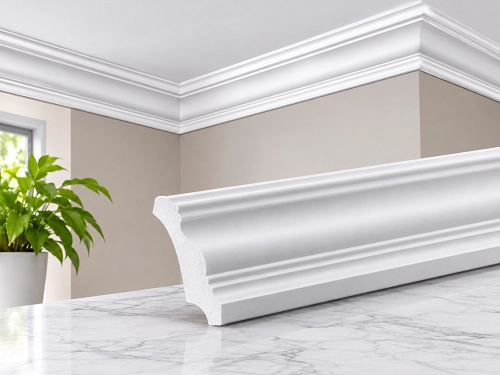
A cornice is a small part of a room that does a lot of visual work. It softens the line where wall meets ceiling, hides small construction gaps and sets the style of the whole space. For decades that job belonged to plaster, gypsum or timber. Today, PU cornice, made from high-density polyurethane, is the practical choice for many projects, because it keeps the carved look and removes most of the weight, fragility and moisture risk.
What Is PU Cornice?
PU cornice is a decorative moulding made from high-density polyurethane and installed along the junction of wall and ceiling. It reproduces the profiles of classic plaster or wood cornice, from ornate carved designs to clean modern lines, but it is lighter, resists moisture and can be cut with ordinary tools.
PU vs Gypsum vs Wood: What Actually Changes on Site
Spec sheets list benefits, but the real difference shows up in handling, risk and labor. According to the manufacturer's FAQ, PU is light and strong, waterproof and mold-proof, resistant to cracking and warping, easy to cut and fix, and can be painted any color. In practice, that means:
- Fewer breakages. Plaster and gypsum chip at the corners during transport and lifting. A lightweight polymer profile is far more forgiving, which matters on long export routes.
- Safer in humid rooms. Kitchens, bathrooms, coastal homes and tropical climates stress wood and gypsum. A waterproof, mold-proof material removes the main failure mode.
- Lower installation effort. Light profiles are easier to hold in position while adhesive sets, so one installer can often handle lengths that would need two people in plaster.
- Lower freight cost. Weight directly affects shipping, which is one reason PU suits importers and distributors.
The trade-off is that PU is a manufactured product, so quality depends on the producer's process control. That is why the buying checklist below matters.
Choosing the Right Profile for the Space
The most common mistake in specifying cornice is choosing a profile from a photo without considering the room. These are the decisions that matter most.
1. Carved or plain?
Carved cornice carries relief detail and suits classical, French-style and hospitality interiors where the ceiling line is meant to be seen. Plain cornice has smooth, clean profiles for modern or minimalist rooms, and it also works well as a calm backdrop when the furniture or wall treatment is already decorative.
2. Scale to the ceiling
As a general design rule of thumb, taller ceilings can carry deeper, more projecting profiles, while low ceilings look heavy with oversized cornice. Because dimensions vary by design, check the size of the specific profile in the product catalog, and ask for a sample before committing a whole project.
3. Do you want hidden lighting?
If you plan cove lighting, choose a profile designed for it. The LED indirect lighting mouldings are shaped to conceal LED strips, so the light washes the ceiling without visible fixtures. Plan the electrical route, the driver location and access for future strip replacement before installation, not after.
4. Think in systems, not single pieces
Cornice rarely works alone. Pairing it with ceiling medallions around chandeliers, flat mouldings as wall bands and panel moulding corners for framed wall layouts creates a coherent scheme and reduces the risk of mismatched patterns from different suppliers.
PU Moulding Range at a Glance
Use this table to match a product to its typical use. Each category links to its full product list.
| Category | What it is | Typical use |
|---|---|---|
| Carving Cornice | Ornate hand-carved cornice profiles | Villas, hotels, formal living rooms |
| Plain Cornice | Clean, smooth cornice profiles | Modern and minimalist interiors |
| LED Indirect Lighting | Mouldings designed to hide LED strips | Cove lighting in homes, hotels, showrooms |
| Carving Flat Moulding | Flat profiles with carved pattern | Wall bands, ceiling borders, panel frames |
| Plain Flat Moulding | Smooth flat profiles | Wall frames, baseboards, simple trims |
| Medallions / Ceiling Rose | Round and shaped ceiling ornaments | Centerpieces around chandeliers and lights |
| Corbels | Decorative support-style brackets | Beams, shelves, door tops, eaves |
| Combined Ceiling Domes | Multi-piece domed ceiling features | Large halls, lobbies, luxury interiors |
The full range, including door frames, fireplaces, Roman columns and PU stone wall panels, is on the main product page.
Installation: What Matters Most
The manufacturer states that PU profiles can be cut with normal tools and fixed with glue or screws. The steps below are general good practice for cornice installation. Always follow the instructions that come with your specific product.
- Acclimatize and dry-fit. Let the profiles rest in the room before fitting, and test the layout along every wall first.
- Prepare the surfaces. Walls and ceilings should be clean, dry and sound, because adhesive only holds as well as the surface beneath it.
- Cut the corners carefully. Use a mitre box or saw guide for internal and external corners, and cut slightly long, then trim to fit.
- Fix securely. Apply suitable adhesive and, where recommended, supplement with screws at the points the product instructions specify.
- Fill and finish. Fill joints and fixing holes with a paintable filler, let it cure, then paint. PU accepts paint in any color, so finish the whole run in one session for an even look.
Ordering Facts to Know Before You Buy
These terms come from the manufacturer's FAQ, so you can plan budgets and schedules with real numbers.
| Topic | What the manufacturer states |
|---|---|
| Minimum order | 100 pieces for standard styles; custom styles depend on the design |
| Production time | About 20–25 days for a 20' container and 25–30 days for a 40'HQ (standard styles) |
| Samples | Available; the sample fee is paid by the buyer and returned when an order is placed |
| Certification | Products are stated to be CE-certified, with quality checks from raw materials to finished goods |
| Packing and shipping | Carton packing, with wooden frames for fragile items; full containers, and EXW terms for small LCL orders |
Custom (OEM) Profiles: How the Process Works
If no existing mould fits your market or project, the manufacturer offers OEM and style customization through an in-house design team. The process described on its FAQ page runs in this order: you share your needs, the team draws the design, you approve it, a sample is made, you confirm the sample, and mass production begins. You can also choose from existing molds or send your own drawings. Because custom tooling affects minimum quantities and lead time, raise it at the start of a project rather than midway.
A Buyer's Checklist
- Request the profile dimensions and the length per piece in writing, and confirm them against the catalog.
- Order a physical sample and check the detail sharpness, surface finish and how it takes paint.
- Ask for the CE documentation that applies to your product and market.
- Confirm packaging for fragile, highly carved items, plus the container loading plan.
- Match every accessory (corners, medallions, flat mouldings) to the same series so the patterns line up.
- For LED profiles, agree the strip type, driver position and service access with your electrician.
About the Manufacturer
OUZHI was founded in 2012 and works from Haining, Zhejiang. The company reports a team of over 100 professionals, with about 50% of its products exported worldwide. Its design department, set up in 2018, has launched nearly 300 new products by hand-drawn design and manual carving, and more than 100 of them hold national design patents. The company has attended the Canton Fair since 2014 and reports long-term customers in markets including Kenya, Turkey, Vietnam, South Africa and India. A new factory with automatic production lines is under construction. You can see completed installations on the global case page and learn more on the about page.
Frequently Asked Questions
Is PU cornice suitable for bathrooms and humid climates?
The manufacturer describes PU as waterproof and mold-proof, which is why it is commonly chosen for damp areas where wood or gypsum can deteriorate.
Can PU cornice be painted?
Yes. The manufacturer states that PU can be painted in any color, so you can match any scheme after installation.
Can I get a profile made to my own drawing?
Yes. OEM and custom designs are available. Send your drawing or sample via the contact page.
Where can I find catalogs?
Catalogs are on the download page, and more answers are on the FAQ page. For ongoing guidance, see the blog and knowledge section.